Understanding How Automated Blog Posting Works Across WordPress and Webhooks
Trendhopper
5 min read
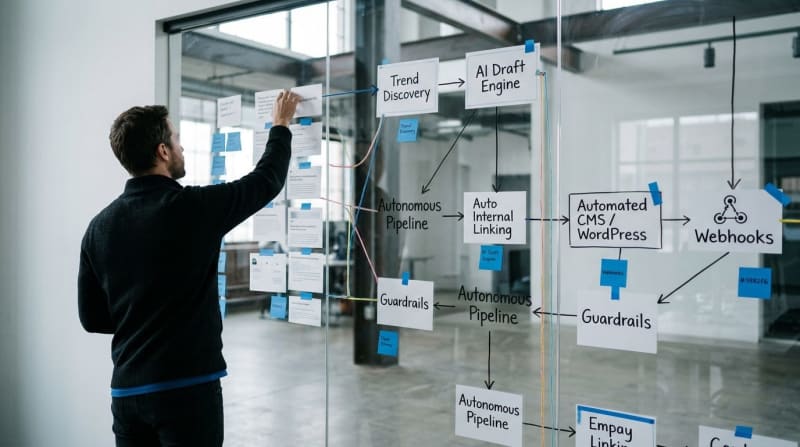
Your development sprint demands every available engineering hour, leaving your company publication schedule stalled for another month. Understanding how automated blog posting works means separating standalone text generators from continuous pipelines that turn raw search queries into indexed CMS entries. Modern systems link keyword research, drafting, internal link mapping, and direct content management system (CMS) integration so articles reach production without manual formatting.
Automated pipelines replace the routine editorial tasks that slow down small marketing teams and solo operators: querying search databases, generating subheadings, pulling internal references, and formatting blocks in a CMS dashboard.
Moving Past Assisted Chatbots to Autonomous Pipelines
Interactive chat tools require constant human steering: writing a prompt, reading the output, requesting revisions, and copying the result into an editor. This pattern speeds up draft production slightly, but the manual friction of managing images, headings, and formatting remains.
An autonomous publishing pipeline replaces this back-and-forth interaction with a defined, sequential flow. The system triggers based on schedule rules or newly discovered search topics, executing each production step programmatically. Instead of waiting for a user to prompt an outline, the engine accepts broad topic boundaries, analyzes search intent, generates structured content, links related pages, and pushes the post to a staging or production CMS.
The core distinction lies in integration. A true automated blogging workflow does not stop at generating text in an isolated interface; it communicates directly with external publishing databases through authenticated application programming interfaces (APIs).
The End-to-End Pipeline from Search Query to Draft
Autonomous content creation operates through four distinct phases before an article touches your live site.
First, discovery tools analyze search databases and community discussions to identify terms with steady search intent. Rather than asking an editor to pore over spreadsheets, the platform maps keyword difficulty, search volume, and entity relationships to select viable subjects.
Second, the system drafts the article against an editorial schema. Instead of producing unstructured walls of text, it populates predetermined fields: metadata descriptions, semantic heading hierarchies (h2, h3), tables, lists, and cited external resources.
Third, an internal linking engine identifies relationships between the new draft and previously published articles. Contextual relevance depends on matching key concepts to existing URLs rather than arbitrarily spraying links across paragraphs. Systems designed around how automated internal linking AI works to strengthen site architecture automatically insert contextually relevant links across new and historical posts, eliminating the need to manage manual tracking spreadsheets.
Fourth, the completed payload moves to the dispatch queue, where delivery rules dictate whether the article publishes immediately, queues as a future post, or sits as a pending draft for human review.
Direct Delivery Through WordPress and Webhooks
Transferring a finished article into a database requires a secure communication bridge between the generator and the target CMS. Most systems achieve this through either native CMS endpoints or flexible webhook payloads.
{
  "event": "post.publish",
  "title": "Understanding How Automated Blog Posting Works",
  "slug": "understanding-how-automated-blog-posting-works",
  "status": "publish",
  "content_html": "<h2>Moving Past Assisted Chatbots</h2><p>...</p>",
  "categories": ["Content Strategy"],
  "tags": ["Automation", "SEO"],
  "meta": {
    "description": "A breakdown of automated blog publishing pipelines."
  }
}
When implementing automated blog posting to WordPress, the software communicates directly with the WordPress REST API. Using application passwords or OAuth tokens, the publishing engine authenticates with your site and sends a POST request containing the title, HTML content, excerpt, featured image ID, category taxonomy, and post status. Plugins or headless connectors can intercept this payload to apply custom themes, schema markup, or custom post types.
For modern headless websites, static site generators, or non-WordPress platforms like Webflow and Ghost, publishing automated content via webhooks provides the necessary flexibility. When an article completes generation, the platform fires an HTTP POST payload formatted as JSON to a designated destination URL. A serverless function, an automation hook, or an integrated backend catches this payload, extracts the fields, and feeds the content into the local database. Platforms like Trendhopper support both methods through standard CMS and webhook integrations, allowing teams to route finished articles to custom headless endpoints or traditional CMS installations.
| Feature | WordPress REST API | Webhook Delivery (JSON) |
|---|---|---|
| Setup Complexity | Low (uses native endpoints or lightweight plugins) | Moderate (requires an endpoint or receiving webhook) |
| CMS Compatibility | WordPress core, multisite, and headless WordPress | Any modern web framework, static site, or API-first CMS |
| Payload Structure | WordPress-standard schema (post fields, meta, terms) | Standard JSON payload tailored for flexible field parsing |
| Publishing Controls | Directly controls draft, pending, or published status | Downstream server handles staging and publishing logic |
| Maintenance | Subject to WordPress plugin updates and auth tokens | Minimal maintenance once the destination route is tested |
Guardrails Against Low-Quality Output
The historic stigma surrounding automated blogging stems from early web scraping and article spinning, which scraped competitor sites and published garbled text to manipulate search rankings. Those sites lacked editorial structure and offered zero value to real users.
Modern hands off blog publishing relies on structured editorial constraints to prevent repetitive phrasing and factual drift. Instead of letting an engine improvise without oversight, an effective architecture enforces strict boundaries across the entire pipeline.
Taxonomy and entity controls keep drafts anchored to the business's specific domain rather than drifting into tangential topics. Draft staging options give teams room to hold incoming posts in a review queue until an editor reviews them, preserving quality control where necessary. Citation verification ensures claims attach to authentic external reference points rather than fabricated figures or nonexistent studies. Finally, strict link thresholds prevent pages from becoming oversaturated with cross-references, preserving both an intuitive reading experience and clean crawl paths for search crawlers. These guardrails ensure that search engines evaluate the resulting content for technical depth and relevance rather than filtering it as low-effort repetition.
Deciding When Autopilot Publishing Fits
Autonomous publishing engines excel at systematic, informational, and search-driven content. They are well suited for glossary entries, technical explainers, recurring industry tutorials, and answers to common search queries across a broad catalog.
Boutique marketing agencies managing multiple client blogs use these systems to maintain consistent publishing cadences without burning through hours of manual CMS formatting. Similarly, lean software teams run hands-off blog publishing to build educational libraries while engineers stay focused on product development.
However, automated systems should not replace every piece of content on your site. High-stakes company announcements, authentic founder retrospectives, crisis communications, and original investigative reporting still require human perspective, personal interviews, and direct judgment.
When your objective is building reliable topical coverage around recurring industry searches, automating the pipeline from keyword discovery to CMS delivery removes the mechanical busywork from your workflow.
If you are ready to streamline your search engine strategy, see how Trendhopper writes and publishes your blog for you.