Outrank so Review for Content Teams Evaluating Autopilot SEO Tools
Trendhopper
8 min read
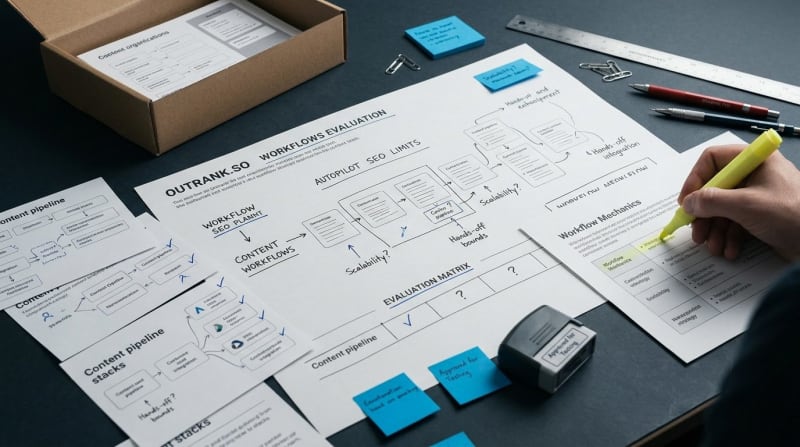
Treating automated content platforms as complete replacements for an editorial team inevitably fills domains with repetitive phrasing and inaccurate product references. Our review of Outrank.so finds that while the platform reliably speeds up SERP analysis and draft generation, it functions best as an accelerated production assistant rather than a completely unmonitored publisher. Content teams evaluating autopilot SEO tools need to balance automated drafting speed against the manual review required to protect site quality.
For early-stage SaaS teams with limited writing bandwidth and agencies managing multiple domains, finding reliable software to handle long-tail keyword execution is a practical necessity. Understanding the core architecture behind Outrank.so helps determine whether it fits into your publishing infrastructure.
Outrank.so in the Content Automation Landscape
Outrank.so operates in the middle ground between interactive text editors and completely autonomous publishing engines. Standard writing assistants require a human operator to prompt every paragraph, research headings manually, and polish formatting inside a document window. Fully autonomous tools, by contrast, monitor keyword queues and push finished pieces directly to a live website. Outrank.so bridges these categories by combining data-driven search analysis with automated long-form generation, giving teams the choice between manual outline refinement and streamlined bulk generation.
The platform targets marketing agencies, niche affiliate publishers, and lean B2B growth teams that need to scale content production without hiring armies of freelance writers. For these users, the traditional bottleneck is not a lack of topic ideas; it is the sheer labor required to analyze top-ranking pages, extract semantic entities, build comprehensive heading structures, and draft initial content.
Because Outrank.so integrates live search data directly into its generation flow, it avoids the hollow phrasing common to generic AI writing tools. For teams auditing various platforms, our comparative breakdown of autopilot SEO blog tools outlines how different architectures handle this transition from raw search data to finished post.
Understanding where a tool falls along this spectrum determines how your team will interact with it on a daily basis. Assisted tools keep writers seated in an editor interface, whereas autonomous solutions operate quietly in the background until an article is ready for live staging. Outrank.so leans closer to the hands-on end of that spectrum, preserving touchpoints where editors can tweak headings, alter prompts, and review keyword densities before the software produces finished copy.
Mechanics of the Generation Workflow
The typical Outrank.so workflow starts with a target search query. Once a keyword is submitted, the system scrapes the live search engine results pages, extracting content structures, heading patterns, frequently asked questions, and related entities from the top-ranking URLs. Instead of forcing users to sift through these competitor pages manually, the platform aggregates this data into a structured brief.
From this competitive brief, the Outrank.so AI content generator constructs a draft outline. Content managers can adjust headings, reorder sections, add proprietary talking points, or accept the algorithm's suggested structure as presented. This stage represents the primary control point for editorial teams, as decisions made within the outline dictate the depth and angle of the resulting draft.
Once the outline is confirmed, the engine expands each section into full prose, incorporating related semantic keywords to satisfy on-page topical coverage criteria. The system generates text section by section, attempting to answer the implicit search intent behind each sub-heading while maintaining stylistic consistency across the document.
After drafting, the built-in optimization dashboard scores the article against current ranking benchmarks. It tracks keyword frequency, heading distribution, reading level, and semantic entity inclusion. Users can edit text directly within the platform's editor to increase the content score before exporting.
Content handoff occurs through multiple channels. Outrank.so provides integrations and export pathways for platforms like WordPress, as well as webhook access and document export options. This allows teams to push finalized drafts into their CMS staging environments without manual copy-pasting.
Production Advantages for Scaling Teams
For organizations balancing strict client deadlines or aggressive organic growth goals, Outrank.so introduces concrete operational efficiencies.
First, it substantially compresses draft turnaround times. Manually conducting SERP research, outlining an article, and drafting a comprehensive post typically consumes the better part of a writer's workday. Outrank.so completes the competitive data aggregation and initial draft assembly in a fraction of that time, letting editors start their work at the revision stage rather than staring at a blank document.
Second, it standardizes on-page optimization across rotating teams of writers. In agency environments where multiple freelancers or junior content marketers produce copy, maintaining uniform keyword density and entity coverage is notoriously difficult. The platform's scoring parameters provide objective benchmarks, ensuring every piece meets baseline search optimization standards before client delivery.
Third, the software functions as practical automated blogging software for agencies seeking to protect operational margins. Rather than expanding full-time editorial headcount as client accounts scale, agencies managing client deliverables can assign junior editors to polish automated drafts. This structure keeps production costs predictable while significantly increasing monthly output.
| Feature Area | Assisted SEO Editors | Outrank.so Workflow | Fully Autonomous Engines |
|---|---|---|---|
| Topic & SERP Research | Manual review of competitor tabs | Automated scraping and aggregation | Background queue discovery |
| Draft Creation | Sentence-by-sentence prompting | Single-click from approved outline | Fully hands-off generation |
| Optimization Scoring | Real-time interactive grading | Real-time interactive grading | Pre-optimized before publication |
| CMS Publishing | Manual copy-paste or plugin sync | Direct integration or manual export | Scheduled, hands-off auto-publishing |
| Editorial Control | High (human writes/edits every line) | Moderate (human approves outline/draft) | Low (review post-publish or queue-based) |
The Boundaries of Hands-Off Execution
Despite the promise of automated publishing, treating any AI-driven writing engine as an unmonitored setup introduces serious strategic risks. An honest Outrank.so SEO review must address the clear boundaries where automation ends and human editorial scrutiny must take over.
The most prominent limitation involves factual accuracy and nuanced subject expertise. Like all large language models, the underlying text generation engines can hallucinate facts, misquote industry regulations, or cite outdated market details. When generating content for technical B2B niches or local service firms, an automated draft will frequently produce generic commentary rather than actionable advice. A human editor must verify all factual assertions, tool names, and procedural steps.
Furthermore, automated internal linking remains an area where human context is vital. While software can identify keyword matches across an existing domain, it often lacks the strategic awareness to build deliberate topic clusters that guide users toward high-converting product pages. If you rely entirely on automated publishing routines without following essential internal linking steps, your site architecture can quickly become disordered.
Unedited drafts also tend to exhibit stylistic repetition. Introductory sentences often rely on identical syntactic formulas, rhetorical questions appear with predictable frequency, and conclusions frequently summarize the preceding paragraphs without adding a distinct forward-looking takeaway. High-performing content teams treat Outrank.so's output as an advanced first draft, dedicating human time to refining voice, inserting original examples, and verifying claims.
Search engines have also grown more adept at identifying low-effort programmatic content that merely rephrases existing web pages. When software scrapes the top ten results and generates an amalgamation of their headings, the new article adds zero unique information to the web index. Editors must actively inject proprietary data, contrarian opinions, screenshots, or original commentary to ensure the piece earns and retains organic rankings.
Practical Use Cases for Content Teams
Deploying the Outrank.so AI content generator delivers the highest return when aligned with specific content formats and team configurations.
Informational glossaries and top-of-funnel coverage represent the easiest operational win. Building topical authority requires answering dozens of basic definitional questions and search queries across an industry. These informational pieces rarely require proprietary company data or deep narrative reporting, making them ideal candidates for automated generation paired with light editorial proofing.
Agency production workflows with dedicated reviewers gain equal leverage. Agencies can assign junior editors to review and polish generated drafts. The tool handles the tedious outline scraping and entity mapping, while the editor ensures client brand guidelines and localized nuances are preserved.
Publishers running affiliate or resource websites often need rapid coverage across broad category trees. Outrank.so allows these publishers to establish baseline topical relevance quickly across hundreds of subtopics without exhausting their freelance budget on introductory explanations.
Conversely, the platform is ill-suited for thought leadership, original investigative journalism, customer case studies, or detailed software product comparisons that require hands-on interface testing. Attempting to automate these formats results in hollow copy that fails to convince discerning readers.
Evaluating How Outrank.so Fits Your Stack
Deciding whether Outrank.so fits your operating model comes down to how your team allocates editorial time. If your primary bottleneck is spending hours reviewing Google search results and assembling outlines by hand, Outrank.so resolves that friction effectively. It accelerates the research phase while keeping your team in control of the document editor.
If, however, your team lacks the internal hours to interact with document editors, review outlines, and manually coordinate publication schedules, an assisted tool may still demand too much human management. Teams facing severe bandwidth constraints often find that autonomous systems, such as Trendhopper, which manages autonomous topic discovery, writing, internal linking, and direct auto-publishing to WordPress or hosted blogs, better solve the ghost-town blog problem by removing the need for daily manual oversight.
Before committing to a subscription, assess your production goals against three practical criteria:
First, determine your required publication volume. If you need only a couple of highly customized articles per month, a simple writing assistant is sufficient. If you need a substantial volume of optimized articles each month across multiple clusters, automated generation platforms become economically sensible.
Second, audit your editorial resources. Ensure you have clear ownership over who will review generated drafts, verify factual statements, and insert unique business insights before pieces go live.
Third, review your technical integrations. Verify that the platform's CMS export paths match your site infrastructure, allowing your team to move drafts into production without complex reformatting. Evaluating Outrank.so through this operational lens ensures you choose software that integrates cleanly into your existing content engine.